The relationship between cannabis and Mexican culture is deeper and more complicated than the stereotypes created by the drug war. Mexico did not originate the cannabis plant. Nor can Mexican history be reduced to smuggling, cartels or the imagery American media has repeatedly attached to the word “marijuana.”
The real story crosses colonial agriculture, traditional healing, migration, music, racialized prohibition, scientific reform and the modern fight for legal ownership.
Today, Mexican and Mexican American entrepreneurs are reclaiming a place in the legal cannabis economy.
California edible brand Dulze represents part of that modern shift by importing ingredients from Mexico and bringing flavors such as mango chamoy, horchata and chili watermelon into licensed dispensaries. Its products connect cannabis with Mexican culinary identity without treating that identity as a costume.
Understanding why that matters requires going back several centuries.
Cannabis Arrived in Mexico Through Spanish Colonialism
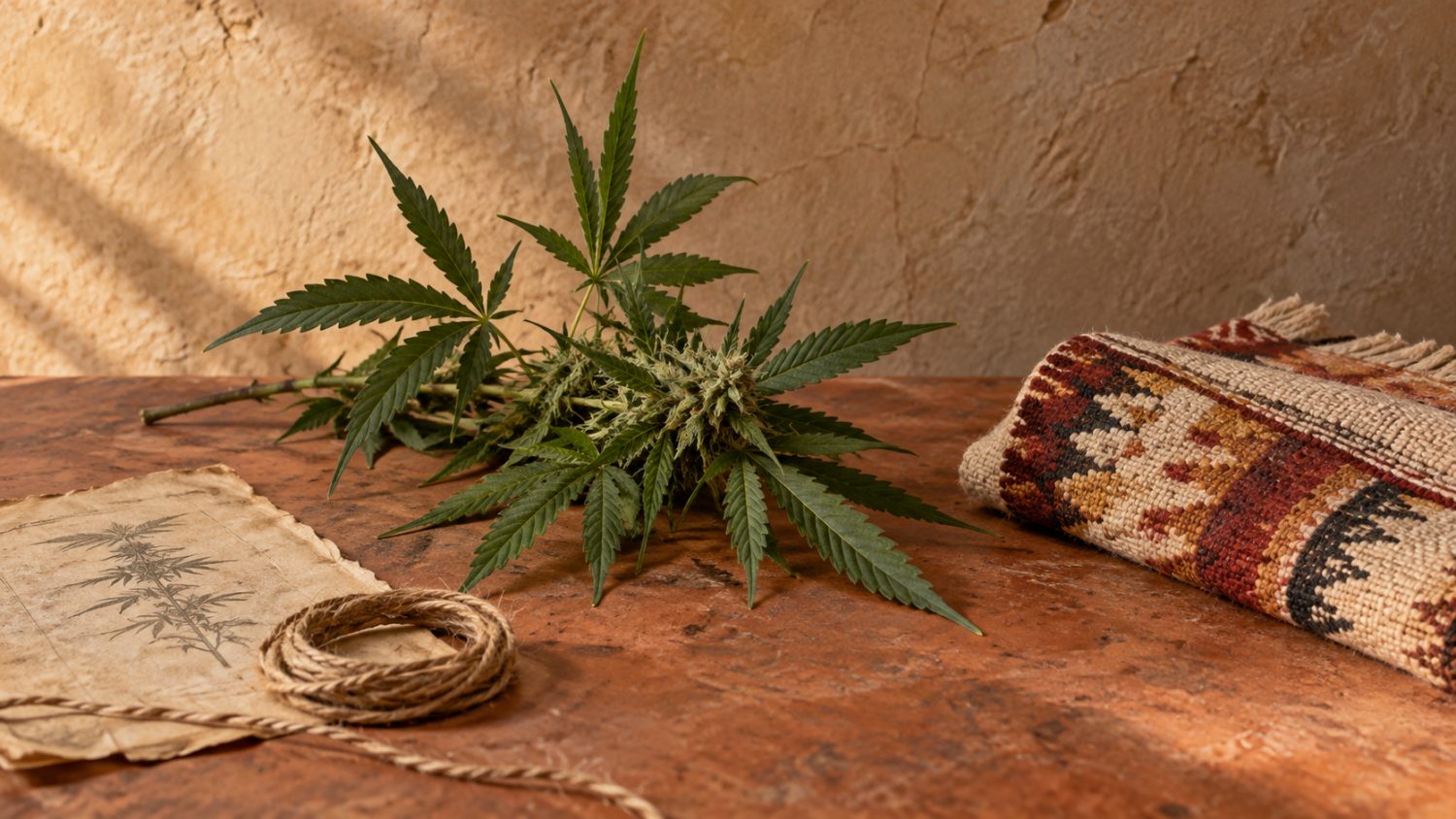
Cannabis is generally understood to have originated in Central or East Asia before spreading through trade and human migration. The plant reached colonial Mexico after the Spanish conquest, primarily because Spanish authorities wanted hemp fiber for rope, textiles and shipbuilding.
Historian Isaac Campos traces the plant’s arrival to the Spanish in the 16th century, when it was brought to New Spain for industrial fiber.
As he explained in a TIME history of cannabis, Mexico and U.S. immigration, the intoxicating use of the plant acquired much of its frightening public reputation in 19th-century Mexico—not first in the United States. Spanish authorities promoted hemp cultivation, but the crop never became the colonial economic engine they imagined.
This history requires an important distinction: the available historical record traces cannabis in Mexico to an Old World introduction rather than a pre-Columbian crop. That does not make its later Mexican uses inauthentic. Communities can adopt an introduced plant and give it distinct local meanings, including medicinal ones.
Mexican folk practices eventually used cannabis preparations for pain, rheumatism and other physical complaints. Cannabis could be soaked in alcohol and applied externally, placing it within a broader tradition of plant-based remedies. Those practices developed through cultural adaptation—the process of taking an introduced plant and giving it local meaning.
“Marijuana” Became a Racialized Word
The precise origin of the Spanish word marihuana, later rendered as marijuana in English, remains disputed. What is clear is that the word became politically useful in the United States during the early 20th century.
It is also important not to reverse the historical sequence. According to Campos, Mexican newspapers and officials had already associated marijuana with prisons, soldiers, violence and social marginality during the 1800s. U.S. prohibitionists later absorbed those fears into a racial politics aimed at Mexican immigrants and other marginalized communities.
Cannabis medicines were already familiar to American pharmacies, where they were generally labeled cannabis or cannabis indica. The Spanish-language term created distance between those products and the smokable plant associated in newspapers with Mexican laborers and immigrants.
Following the Mexican Revolution, migration from Mexico into the United States increased. Politicians and newspapers began circulating stories portraying “marihuana” as a foreign vice that caused violence, insanity and moral decline. The claims were rarely grounded in credible evidence, but they supported broader anti-Mexican prejudice and demands for immigration control.
California played an early role. Historian Dale Gieringer’s research into the origins of cannabis prohibition in California traces how state restrictions developed amid sensational stories connecting cannabis with Mexican communities. His account also cites a 1914 police raid on two so-called “dream gardens” in Los Angeles’ Sonoratown neighborhood, where officers reportedly removed a wagonload of cannabis.
The campaign transformed more than drug policy. It turned Mexican identity into part of the supposed evidence against the plant.
Cannabis in Revolutionary-Era Mexican Culture
Cannabis was already visible within Mexican popular culture by the period surrounding the Mexican Revolution, which began in 1910. Soldiers, prisoners and working-class communities were frequently linked with its use in songs, folklore and press coverage.
“La Cucaracha,” one of the best-known songs associated with the revolution, circulated in many versions, including a widely repeated verse referring to marijuana. Because the song predates the revolution and its lyrics changed across regions and political moments, it should be treated as popular folklore—not as a literal documentary record. The cannabis verse nevertheless shows that marijuana had entered popular humor and political commentary.
That visibility did not mean cannabis was universally embraced. Mexico prohibited cannabis nationally in 1920, a date confirmed in Campos’s historical account, well before the United States enacted the federal Marihuana Tax Act in 1937.
A U.S. Customs and Border Protection history of the 1937 law notes that although the statute was framed around taxation and registration, it effectively curtailed recreational cannabis and burdened industrial hemp as well.
The drug war was therefore not simply imposed by one country on another. Mexican officials participated in prohibition, while pressure from the United States helped shape the larger regional system that followed.
Mexico Experimented With a Public-Health Approach in 1940
One of the most overlooked chapters arrived in 1940, when Mexico briefly treated drug dependence as a public-health issue rather than primarily as a criminal matter.
Mexican psychiatrist Leopoldo Salazar Viniegra challenged sensational claims about cannabis and argued that punishment was failing. Mexico adopted a short-lived system in which people dependent on drugs could receive controlled supplies through medical channels.
The experiment lasted only months. In a peer-reviewed study published in Foro Internacional, political scientist Carlos A. Pérez Ricart documents how pressure from multiple U.S. government institutions contributed to the regulation’s suspension in June 1940.
The episode involved diplomacy, international treaty arguments and access to pharmaceutical drugs. That context is important because it would be inaccurate to say the program simply failed on its own.
The experiment remains significant because Mexican reformers were questioning punitive drug policy decades before contemporary legalization. They recognized that stigma, incarceration and illegal markets could create more damage than the substances policymakers claimed to control.
Mexican Identity Was Used to Build U.S. Cannabis Prohibition
In the United States, federal prohibition expanded through many of the same narratives previously used at state and local levels. Federal Bureau of Narcotics commissioner Harry Anslinger promoted frightening stories about marijuana during the 1930s. The campaign associated cannabis with Mexican immigrants, Black musicians, crime and sexual danger.
Congress passed the Marihuana Tax Act in 1937, using a tax-and-registration structure to suppress the plant nationally. That federal campaign was racist, but, as the historical scholarship makes clear, it also drew on prohibitionist ideas that had already circulated in Mexico.
The language had done its job. “Cannabis” sounded medicinal and scientific, while “marijuana” had been framed as foreign and dangerous.
That history is why modern discussions about terminology can become emotional.
Some advocates prefer cannabis because marijuana was weaponized through racist propaganda. Others, including many Mexican and Latino consumers, have reclaimed marijuana as part of their own language and culture.
There is no single word every community must use. The essential point is understanding the history attached to it.
Cannabis Remained Present in Mexican American Life
Prohibition never removed cannabis from Mexican or Mexican American culture. It pushed the plant underground and increased the consequences attached to it.
Across the Southwest and California, cannabis remained part of informal healing, neighborhood economies, music and social life. Later generations encountered it through Chicano culture, lowrider communities, rock, punk, reggae and West Coast hip-hop.
Artists including Cypress Hill made cannabis highly visible within Mexican American popular culture. Their work did not represent every Chicano experience, but it rejected the idea that cannabis use had to remain hidden or shameful.
At the same time, Latino communities continued facing arrest, incarceration, deportation exposure and barriers to employment or housing. The cultural influence was celebrated while people within the culture frequently absorbed the punishment.
That contradiction followed cannabis into legalization.
Legalization Did Not Automatically Create Latino Ownership
California legalized medical cannabis through Proposition 215 in 1996 and adult use through Proposition 64 in 2016. The state’s official cannabis-law timeline identifies those voter-approved measures as the foundations of California’s medical and adult-use systems.
Those changes created an enormous regulated industry, but a legal market did not guarantee that Mexican American entrepreneurs would receive an equitable share of ownership.
Licensing fees, real-estate costs, taxes and limited access to capital created barriers for small operators. Immigration status and the continuing federal prohibition of cannabis added further complications for some families.
Latino culture could still be used to sell products even when Latino founders, growers and retailers struggled to enter the market. Packaging could borrow from Mexican candy, Día de los Muertos imagery or Spanish slang without creating actual ownership or returning value to the communities being referenced.
That is why ownership and authenticity matter.
Dulze Brings Mexican Culinary Culture Into Legal Cannabis
Dulze represents a modern effort to build Mexican identity into cannabis from the inside rather than applying it as surface-level branding.
Founded by chef Mike Moya, Dulze describes itself as California’s first Mexican-owned infused-gummy brand. That “first” designation should be understood as a company and media claim rather than a finding from a public ownership registry.
Independent Latino outlet Remezcla has profiled Dulze as a Mexican-owned artisan gummy company, while High Times covered Moya’s original launch and Mexican-inspired flavors in 2020.
Its reported lineup has included chili watermelon, mango chamoy, horchata, margarita, piña colada and Piña Loca. The company recently brought 100MG gummy bars with two flavors to market, strawberry and cucumber lime, both with tajin.
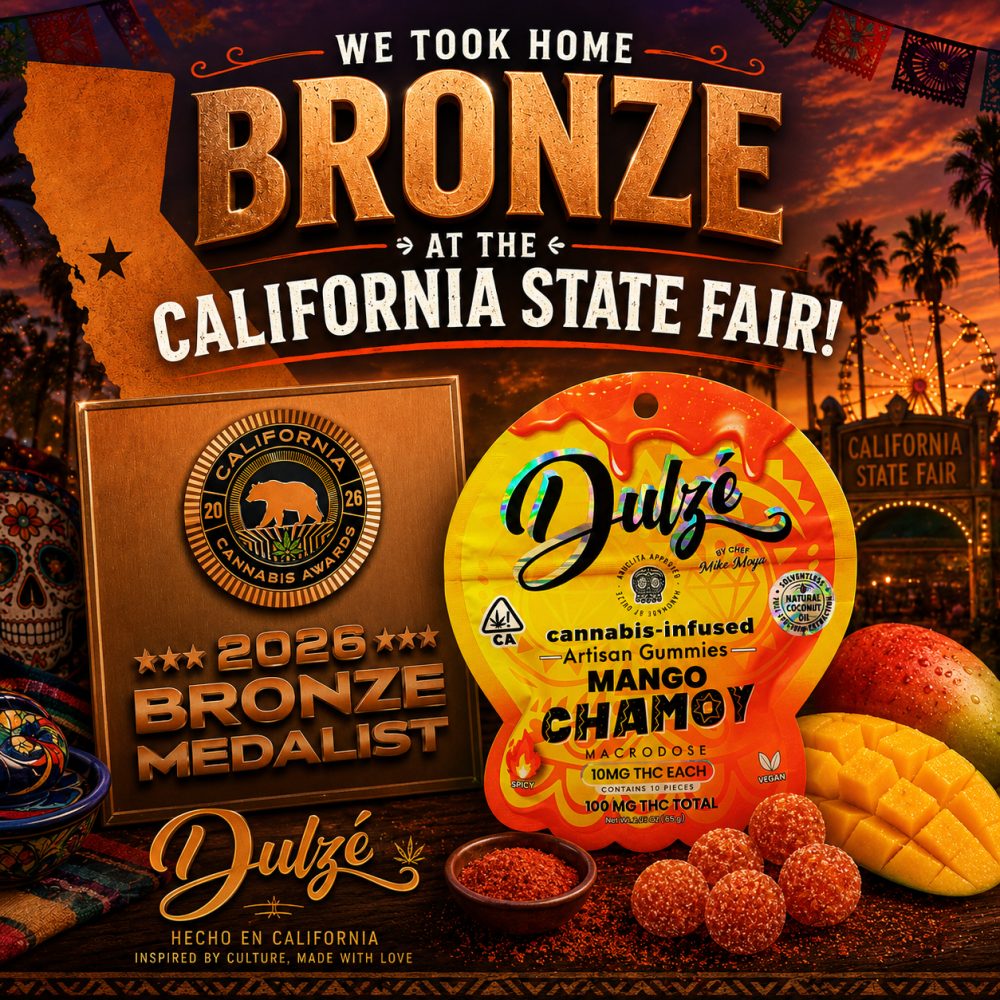
In its feature on the brand, Remezcla described DULZE as an artisan gummy company built around traditional Latino flavors and multiple dosage options.
Because product lineups, formulations and availability can change, consumers should confirm the current menu, cannabinoid content and package potency through Instagram here, or a licensed retailer before purchasing.
Those flavors are not random selections. Chamoy, chile, mango, watermelon, pineapple and horchata carry strong connections to Mexican street food, candy shops, mercados and family gatherings. Moving them into regulated cannabis allows the product to communicate culture before the consumer even opens the package.The company offers a product that can be recognizably Mexican without leaning on the violent imagery that has historically dominated conversations about Mexico and cannabis.
That distinction is crucial because similar to Colombia and narco culture, Mexican cannabis culture is not synonymous with cartel culture. It includes farmers, patients, chefs, scientists, artists, activists and entrepreneurs. Dulze puts an award-winning chef and culturally specific flavors at the center of its story.
Modern Mexican Cannabis Culture Is About Reclamation
Mexico’s legal landscape continues to evolve. Congress authorized medical cannabis reforms in 2017. After a series of decisions protecting personal adult use, Mexico’s Supreme Court issued a 2021 general declaration invalidating statutory provisions that imposed an absolute administrative ban on recreational self-consumption.
That judicial change did not automatically create a licensed national adult-use retail market. As of this article’s September 2026 update, Mexico still should not be described simply as having California-style recreational legalization. Personal consumption, possession limits, cultivation, government authorization and commercial sales remain legally distinct questions.
On both sides of the border, however, the cultural change is already visible.
Mexican and Mexican-American professionals are entering cultivation, manufacturing, retail, media, advocacy and culinary product development. They are telling stories that extend beyond prohibition and trafficking. They are also asking who gets to profit from legalization after generations of criminalization.
Buying from a Mexican-owned company will not repair the drug war by itself. Ownership still matters because it changes who has the power to define the product, employ people, preserve cultural context and build long-term value.
Mexico’s relationship with cannabis is not one continuous tradition. It is a history of introduction, adaptation, criminalization and reclamation.
Spanish colonizers brought hemp to New Spain. Mexican communities incorporated cannabis into folk practices and popular culture. Governments on both sides of the border outlawed it. American politicians used Mexican identity to transform the plant into a racial threat. Mexican scientists challenged prohibition, while Mexican and Mexican American communities lived with its consequences.
The legal era now offers a chance to tell a broader story.
The most meaningful form of reclamation is not simply placing Mexican imagery on a package. It is creating room for Mexican and Mexican American people to own the company, make the product, tell the story and participate in the wealth generated by legalization.
–
Cannabis products are intended for adults 21 and older where permitted by law. Cannabis laws vary by jurisdiction. Consume responsibly, keep cannabis away from children and pets, and never drive under the influence.