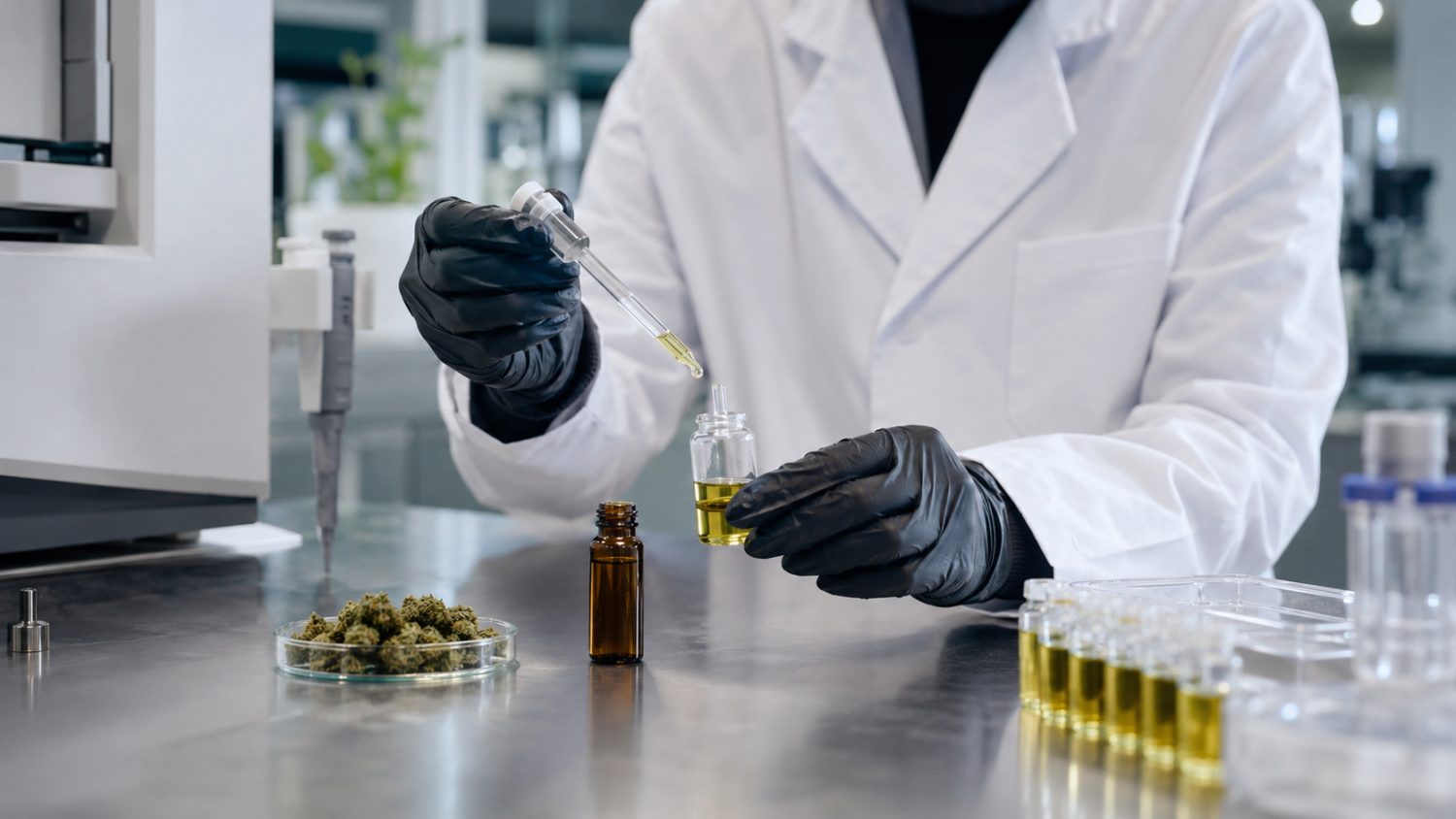
Research and development testing, often called R&D testing, or research and development testing, quality-assurance, or informational testing, serves a different purpose that compliance testing.
For cannabis manufacturers, the most useful time to discover a problem is while there is still time to do something about it. Final compliance testing is essential, but it happens near the end of the production process. By that point, the raw materials have been processed, the formulation has been completed, and the product may already be packaged. If the results reveal unexpected potency, residual solvents, microbial contamination, heavy metals, pesticides, or another issue, the manufacturer has fewer and usually more expensive options.
It can give a manufacturer analytical data during development and production, before the product is submitted for official regulatory compliance testing.
That earlier visibility does not guarantee that a finished batch will pass compliance. It can, however, help a team understand its materials and processes, make evidence-based adjustments, and reduce avoidable surprises at the end.
R&D Testing and Compliance Testing Are Not the Same
Compliance testing determines whether a finished production batch satisfies the requirements of the market in which it will be sold. In California, cannabis must be packaged in final form and pass regulatory compliance testing before retail sale. The licensed laboratory produces a certificate of analysis, or COA, for the official sample.
R&D testing is optional testing performed before that official step. Depending on the product and the question being investigated, it may be used to examine an ingredient, an in-process sample, a prototype formulation, or a product pulled at a defined stage of production.
A research and development test result is not a substitute for the required compliance test. It is a development tool. Its value comes from placing useful information earlier in the decision-making process.
Earlier Potency Data Can Improve Formulation Control
Potency is not simply a label claim added after production. It is affected by the cannabinoid concentration of the starting material, formulation calculations, mixing, processing conditions, and the uniformity of the finished batch.
For infused products, an early potency test can help a manufacturer check whether an input or intermediate mixture is reasonably close to its intended concentration before moving into full production. Testing pilot batches or samples taken after key mixing steps can also help identify whether a formulation or mixing process needs further evaluation.
This matters because a single result only describes the sample analyzed. If the product is not homogeneous or the sample is not representative, one passing number cannot establish that every serving or unit contains the same amount.
A thoughtful research and development plan therefore pairs laboratory analysis with documented sampling locations, batch size, mixing time, equipment settings, and other process information.
The objective is not to “test potency into” a product. It is to use data to develop a controlled process that can repeatedly produce the intended result.
Process Conditions Can Change the Cannabinoid Profile
Heat and time can materially affect cannabinoids. During decarboxylation, acidic cannabinoids such as THCA and CBDA are converted into their neutral forms. Published studies show that the extent of this conversion depends on temperature and exposure time. Research also shows that extended or elevated heat can contribute to cannabinoid degradation.
For manufacturers using thermal processing, doing R&D testing can help compare what is present before and after a defined step. That information may help the production team evaluate whether its actual process is delivering the intended cannabinoid profile.
The laboratory result should be considered alongside the production record. Oven temperature, residence time, vessel size, sample depth, agitation, and exposure to oxygen can all differ between a small trial and a commercial batch. A result from one condition should not automatically be assumed to apply to another.
Testing Inputs Can Reveal Problems Before More Value Is Added
A finished cannabis product may combine cannabis oil or flower with hardware, solvents, flavor systems, carriers, food ingredients, packaging, and other materials. Problems introduced by an input can become more expensive after that input is blended into a larger batch.
Targeted R&D testing may help answer questions such as:
- Does the incoming cannabis material have the expected cannabinoid concentration?
- Are residual solvents present after an extraction or purging step?
- Is a bulk oil reasonably uniform before it is divided among finished units?
- Are pesticides, heavy metals, or microbial contaminants detected in a material before it enters production?
- Does water activity or another stability-related measurement warrant closer process review?
Not every test applies to every material. A laboratory should help determine whether the proposed matrix, method, and sample size are appropriate for the question.
The strongest product manufacturing programs begin with a defined decision—not a broad request to “test everything.”
In-Process Testing Can Help Locate Variability
When a final result is unexpected, manufacturers often need to determine where the variation entered the process. Testing only the finished product provides an endpoint; it does not necessarily identify the cause.
A staged product testing plan can compare samples from selected points, such as the incoming extract, post-decarboxylation material, bulk formulation, and packaged product. When those samples are collected under a documented plan, the results can help a team narrow its investigation.
For example, if the starting oil matches its specification but the bulk mixture does not, the team can focus on formulation math, material transfer, mixing, or sample collection. If the bulk mixture is on target but individual units vary, filling or unit-to-unit uniformity may deserve closer attention.
These comparisons do not prove causation on their own. They provide evidence that can guide a more focused process review.
Earlier Contaminant Screening Can Reduce Late-Stage Surprises
California’s Department of Cannabis Control has explicitly noted that regulatory compliance testing occurs on cannabis goods in final form, at the end of the commercial production chain. The agency has also stated that contamination can occur at multiple points and that prevention is preferable to relying solely on end-product testing.
That distinction is important. A final compliance test is a required safety checkpoint, but it cannot replace sanitation, supplier qualification, good manufacturing practices, equipment maintenance, or process controls.
Earlier contaminant screening can complement those systems. If a manufacturer has a specific reason to question an ingredient, extraction step, storage condition, or production environment, an appropriately designed R&D test may help the team investigate before the material is incorporated into more products.
Because laboratory testing uses samples, it also has limits. Contamination may be unevenly distributed, and no sample can describe an entire batch unless the sampling approach is appropriate and the batch is sufficiently uniform.
Testing should support a preventive quality system—not create false confidence in place of one.
R&D Testing Can Support Repeatability Across Batches
A better product is not only one that reaches a target once. For a commercial manufacturer, quality also means producing comparable results across repeated batches.
Trend data can make this type of testing more valuable over time. Instead of reviewing each result in isolation, manufacturers can compare results against internal specifications and process records.
This may reveal gradual shifts in:
- Raw-material potency
- Extraction performance
- Moisture or water activity
- Mixing consistency
- Other measurable product characteristics
For those comparisons to be meaningful, the company should keep the test method, sampling approach, sample stage, and recordkeeping as consistent as practical. Changing several variables at once makes it difficult to determine why the result changed.
How to Build a More Useful R&D Testing Plan
Before submitting a sample, a manufacturer should be able to explain what decision the result will inform.
A practical R&D testing plan may include:
Define the question. Identify the product attribute, contaminant, or process step being evaluated.
Choose the correct sample stage. Decide whether the useful answer must come from a raw material, intermediate, pilot batch, bulk finished material, or packaged units.
Use a documented sampling approach. Record where, when, and how each sample was collected.
Confirm the appropriate analytical panel. Select tests based on the product matrix, process, jurisdiction, and actual risk—not habit alone.
Establish an internal specification or decision rule. Determine in advance what result would lead the team to proceed, investigate, adjust, or reject a material.
Connect results to production records. Compare analytical data with formulation calculations, equipment settings, processing time, temperature, and other relevant variables.
Retest after a meaningful change. If the team changes the formulation or process, new data may be needed. The previous result only represents the sample and condition tested.
Better Products Come From Better Process Knowledge
This type of testing is most effective when it is part of product development rather than an emergency step immediately before compliance.
Used thoughtfully, earlier testing can help cannabis manufacturers verify assumptions, evaluate inputs, monitor critical process steps, investigate variability, and refine formulations while changes are still possible.
It does not replace compliance testing, good manufacturing practices, or a qualified quality team. It gives those teams better information to work with.
Infinite Chemical Analysis Labs offers quality-assurance and R&D testing services for cannabis businesses, including cannabinoid profiling and a range of targeted analytical panels. Manufacturers should consult the laboratory about the appropriate sample type, test method, and testing strategy for their product and jurisdiction.
Learn more about InfiniteCAL’s California quality-assurance testing services.
Sources
- California Department of Cannabis Control: Current DCC Regulations
- California Department of Cannabis Control: Testing Laboratories and Track-and-Trace Rulemaking
- California Department of Cannabis Control: Cultivation Updates and Minimum Sanitation Standards
- Wang et al.: Decarboxylation Study of Acidic Cannabinoids
- Das et al.: Postharvest Operations of Cannabis and Their Effect on Cannabinoid Content
–
For more updates on testing weed products earlier, subscribe to the official RespectMyRegion.com newsletter.