Paid Advertisement: Artiststore paid Respect My Region for promotional placement in this article. This article contains a paid promotional link to Artiststore. Platform features, product options, pricing, fulfillment terms, shipping, and other services may change. Readers should verify current information directly with Artiststore before opening a store or placing an order.
One finished illustration can feel like one finished product. Put it on a print, perhaps a sticker too, and you are done—right? You’ve got some merch. Not quite. A strong illustration may contain a main character, smaller motifs, a recognizable palette, and an expression fans cannot stop talking about. The goal is not to paste the same rectangular image onto everything. It is to uncover several connected product ideas.
Here is how to turn one piece of merch into a focused collection without creating five new illustrations from scratch.
Start by Finding the “World” Inside the Illustration
Before turning artwork into merchandise, make sure you own or have the necessary rights to commercially use every character, logo, phrase, image, and other protected element included in the design. Look at the artwork as a design system. What would someone recognize if the full composition disappeared? It might be a character silhouette, symbol, flower, weapon, animal companion, or tiny background object.
List the elements that can stand alone:
- The main character or focal object.
- One to three supporting motifs.
- A distinctive expression, pose, or accessory.
- The core color palette.
- A short original phrase, if the artwork already includes one.
These pieces become your collection’s visual vocabulary. If you plan to sell your art online through print-on-demand, separating them makes different formats easier to test without purchasing finished inventory first.
Give Every Piece of Merch or Products a Different Job
A merch collection becomes more interesting when each item offers a different way to enjoy the art. Before choosing products, decide what role each one should play.
| Collection Role | Possible Product | Best Use of the Artwork |
| Full-scene feature | Preserve the complete composition and background | |
| Character centerpiece | Acrylic standee or keychain | Isolate the main figure with a clean silhouette |
| Small everyday item | Sticker or pin | Use one bold symbol, face, or accessory |
| Coordinating extra | Mini sticker design | Turn a secondary motif into a companion piece |
This prevents the “same image, different object” problem. A print preserves detail, a keychain makes the character portable, and a sticker can spotlight the background creature fans noticed before you did.
Adapt the Merch Artwork Instead of Simply Resizing It
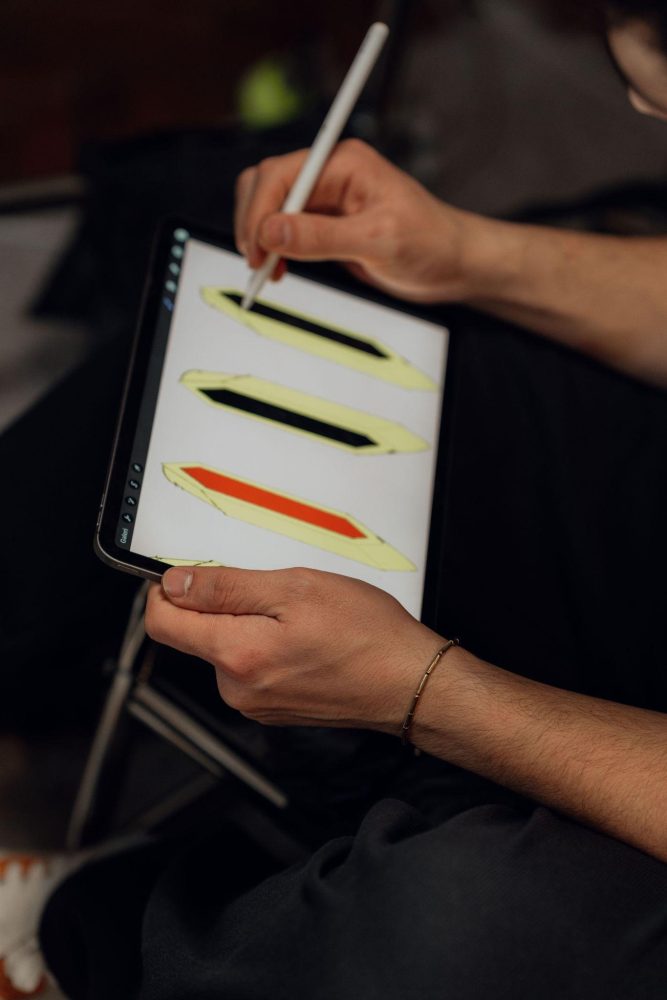
Artist creating multiple color variations of one design on a digital tablet. Photo credit: Vograce
An illustration designed for a screen may lose impact on a small product. Fine lines can disappear, text can become difficult to read, and a detailed background can overwhelm the character.
Create a separate working file for every format. Depending on the product, you may need to:
- Remove or simplify the background.
- Strengthen a delicate outline or small shape.
- Reposition faces and important details away from cut lines.
- Increase contrast between nearby colors.
- Remove text that becomes unreadable at the finished size.
- Adjust the crop instead of squeezing the full composition into a new shape.
Always follow the manufacturer’s template, file format, resolution, bleed, and safe-area instructions for that specific item. Requirements can differ even within the same product category.
Test at the Real Size
View the design at its approximate finished dimensions and print a paper test when possible. Can you recognize the expression? Is the smallest text readable? Does the silhouette still make sense?
A mockup helps with placement, but when practical, order a physical sample before launching so you can personally evaluate the size, color, material, finish, edges, and artwork position.
Keep the Collection Cohesive, Not Identical
Cohesion comes from repeating deliberate choices. Use the same palette, outline treatment, typography, border style, or recurring motif. Different artwork crops can still feel connected.
For example, a four-piece collection could include:
- A print featuring the complete illustration.
- A keychain focused on the main character.
- A pin based on the character’s emblem.
- A sticker featuring the companion or background motif.
That is already a collection. Adding more products only helps when each one contributes something new.
Let Demand Shape the Next Version of Merch

Person checking audience reactions and engagement on social media using a smartphone. Photo credit: Vograce
You do not need to predict the perfect collection. Show followers a few mockups, ask what they would genuinely use, and note which details they mention. A poll surely helps, but orders provide stronger evidence than likes!
Artiststore’s print-on-demand model can reduce the need to purchase finished inventory in advance because products are made after a customer places an order. Artists should still review current production, shipping, payment, and fulfillment costs when setting product prices and margins.
Start with a focused selection, then use sales patterns to decide what deserves a variation, matching product, or expanded series.
Also, do not assume the largest illustration will necessarily attract the most customer interest. Sometimes a tiny mascot, dramatic expression, or simple symbol may translate particularly well to merchandise because it remains recognizable across several sizes.
Present the Products as One Story
When the collection is ready, show how it grew from the original illustration. Reveal the complete artwork, then the details that became products. A sketch-to-product carousel can connect the items.
Give the collection one name and use consistent product photography. Similar backgrounds and lighting make separate items feel like a planned release.
Building a merch collection from one illustration is less about making more art and more about seeing the art differently. The complete scene, central character, smallest symbol, and supporting palette can each serve a separate purpose.
Begin with a few products, adapt every design to its format, and keep the visual connection clear. One illustration can become a convincing product line when every item reveals a different part of the same world.
–
Platform Disclaimer: Artiststore features, product availability, production costs, shipping costs, fulfillment times, integrations, policies, and other terms may change. Artists are responsible for ensuring they have the necessary intellectual property rights for artwork and other content they sell. Review Artiststore’s current terms, policies, product specifications, and costs before creating or selling products.