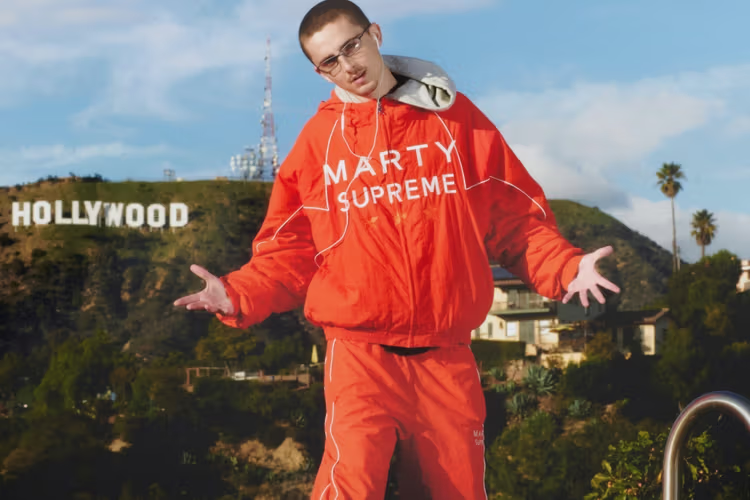
Timothée Chalamet is no longer a rising star. That phase is over. What he represents now is far more interesting and far more difficult to sustain. Chalamet exists in a rare space where cultural relevance, box office credibility, and artistic seriousness intersect without one fully cannibalizing the other.
In 2026, he seems to be defined by work, not mystique. Strip away the fashion headlines, red carpet photos, and internet fascination, and what remains is a filmography that explains exactly why he occupies the position he does today. He is no longer operating on promise or potential. He is operating on results, range, and a growing body of performances that span prestige drama, blockbuster spectacle, and culturally resonant storytelling.
In an era where fame is often louder than talent or talent is buried beneath algorithmic noise, Chalamet has managed to build a career that still feels like he’s human but also a superstar at the same time.
His evolution is interesting for many reasons, but to me, it reflects a broader shift in how audiences connect with artists.
Chalamet is not simply famous, he is trusted.
Trusted to choose interesting projects.
Trusted to take risks.
Trusted to respect the audience rather than pander to it.
That trust is what separates a moment from a legacy.
From Breakout to Benchmark w/ Timothée Chalamet
Timothée Chalamet’s career did not just begin with acclaim, it began with a performance that set an unusually high bar. His role in Call Me by Your Name remains a reference point because it established his core strengths early. Emotional intelligence, restraint, and the ability to communicate inner conflict without overplaying it.
What matters now is that the performance still holds up. Many breakout roles feel tied to their moment. This one continues to feel foundational. It was not a fluke. It was a preview.
That film positioned Chalamet as a serious actor immediately, but it also created pressure. The industry wanted him to repeat that tone endlessly. Instead, he diversified.
Proving Range Without Abandoning Credibility
After his initial success, Timothée Chalamet made a deliberate choice to test himself across genres while maintaining artistic credibility. Films like Beautiful Boy showed his willingness to inhabit emotionally raw territory, portraying addiction and vulnerability without romanticizing it. The performance required discomfort and honesty, two qualities that have become recurring themes in his work.
In Little Women, he demonstrated a different skill set entirely. Charm, timing, and romantic energy balanced with emotional immaturity. The role proved he could hold his own within ensemble casts and classical adaptations without fading into the background.
These projects mattered because they established consistency. Chalamet was not bouncing between tones randomly. He was expanding his range while reinforcing trust.
What Chalamet did instead was slow the narrative down. He did not rush to dominate every genre. He did not overextend himself into projects that diluted his credibility. Instead, he curated a filmography that mixed scale with specificity.
Stepping Into Franchise Scale With Intention
The true inflection point in Timothée Chalamet’s career came when he entered blockbuster territory without sacrificing identity. Dune and Dune Part Two changed how the industry viewed him.
As Paul Atreides, Chalamet carried a massive, dense narrative that required both physical presence and psychological depth. This was not a quippy franchise role. It demanded gravity, patience, and a believable evolution from uncertainty to authority.
What stands out in hindsight is how restrained his performance remained, even as the scale increased. He did not inflate the character to match the spectacle. He grounded it.
That choice paid off. Dune Part Two solidified him as a legitimate box office anchor rather than a prestige actor dabbling in blockbusters.
The Wonka Risk and Why It Worked
On paper, Wonka looked like a gamble. Musical elements, legacy IP, and inevitable comparisons to previous portrayals created real risk. Chalamet approached the role by refusing imitation. He leaned into whimsy, vulnerability, and sincerity rather than caricature.
The result was a performance that felt earnest rather than cynical. It expanded Timothée Chalamet’s audience significantly without undercutting his credibility. Importantly, it showed he could lead a commercially accessible film while still injecting personality and nuance.
Wonka proved Chalamet could translate his appeal across demographics. That versatility is a major reason his career remains durable.
Marty Supreme and the Mature Phase
By the time Timothée Chalamet arrived at Marty Supreme, the question was no longer whether he could carry a film. It was how he would choose to use that power.
Portraying real life table tennis legend Marty Reisman required transformation, aggression, arrogance, and an unpolished edge. This was not a likable character in the traditional sense. Chalamet leaned into that discomfort fully. The performance emphasized obsession and ego over charm.
This role represents where Chalamet is now. Less concerned with approval, more focused on challenge. Marty Supreme feels like the work of an actor confident enough to let a character repel as much as attract.
What Ties His Performances Together
Across genres and budgets, Timothée Chalamet’s work shares clear traits. He commits fully. He avoids irony. He allows characters to be contradictory. He rarely over explains emotion. These choices create performances that invite audiences in rather than instruct them how to feel.
Another key detail is preparation. Directors consistently note his investment in research, physical transformation, and rehearsal. This professionalism shows on screen. His performances feel lived in rather than assembled.
As of now, he is no longer measured against his peers. He is measured against himself. That is a subtle but powerful shift. It means his performances are judged on depth, transformation, and intent rather than novelty.
One of the most impressive aspects of Chalamet’s current position is how he handles visibility. He is highly recognizable, constantly photographed, and deeply embedded in popular culture. Yet his presence never feels exhausting.
This is not accidental. Timothée Chalamet has avoided the trap of omnipresence. He does not flood social media with forced relatability. He does not chase virality. When he appears, it is usually attached to work, fashion moments that feel expressive rather than calculated, or interviews that reveal thought rather than performance.
In today’s media environment, restraint is power. Chalamet understands that. By not always being available, he preserves intrigue. By not explaining everything, he allows the work to speak.
The Actor First Mentality
At the core of who Timothée Chalamet is now is a simple truth. He prioritizes acting.
That may sound obvious, but it is increasingly rare. Many actors become brands before they become fully formed artists. Chalamet resisted that shift. Even as his profile grew, he continued to choose roles that demanded vulnerability, discomfort, and transformation.
His recent performances reflect an actor willing to look unpolished, obsessive, arrogant, fragile, or physically altered if the role requires it. There is no visible fear of being unlikable. That is a critical distinction. Actors who chase approval often flatten their performances. Actors who chase truth take risks.
Chalamet is firmly in the second category now.
Cultural Impact Beyond Film
Timothée Chalamet’s influence extends beyond cinema, but not in a hollow way. His fashion presence, for example, feels personal rather than manufactured. He treats style as expression, not endorsement. That authenticity resonates because it mirrors how younger audiences actually engage with identity.
He does not dress to dominate trends. He dresses to signal curiosity and individuality. That approach has quietly reshaped expectations for male celebrities, especially in spaces that previously rewarded conformity.
In music, art, and youth culture more broadly, Chalamet functions as a bridge. He is respected by critics, embraced by fans, and referenced organically rather than pushed through campaigns. That kind of influence cannot be bought. It has to be earned over time.
Navigating Masculinity in a New Era
Another reason Timothée Chalamet matters right now is how he embodies masculinity without performing it. His presence challenges outdated assumptions about what leading men must look like or act like to carry a film.
He does not rely on physical dominance. He does not posture. He allows softness, uncertainty, and emotional openness to exist alongside intensity. That balance reflects where culture actually is, not where it used to be.
For many viewers, especially younger ones, this representation feels honest. It validates a version of masculinity that is thoughtful rather than aggressive, expressive rather than performative.
Choosing Projects That Mean Something
At this stage in his career, Timothée Chalamet’s project selection tells a story. He moves between large scale films and intimate character studies without losing coherence. The throughline is intention.
He appears drawn to characters who are driven, flawed, and searching. These are not passive roles. They demand engagement. They ask the audience to sit with complexity rather than resolve it quickly.
That consistency builds trust. Audiences may not always know what kind of film they are walking into, but they know it will likely be thoughtful, committed, and emotionally grounded.
Relationship With the Industry
Chalamet’s current relationship with Hollywood is one of mutual respect rather than dependency. Studios value him because he brings credibility and audiences. Directors value him because he commits fully to process. He does not feel interchangeable.
At the same time, he does not appear interested in controlling the narrative or positioning himself as a gatekeeper. He collaborates. He listens. He adapts. That humility matters in an industry that often rewards ego.
As of now, he occupies a position that allows him to say no, which is one of the most powerful positions an actor can reach.
Public Perception Versus Reality
Public perception of Chalamet often focuses on surface level elements, fashion, fame, or relationships. The reality is more grounded. He works consistently. He prepares deeply. He treats acting as a craft rather than a platform.
That separation between perception and reality protects longevity. When trends shift, the work remains. When hype cools, the foundation holds.
This is why his career feels stable rather than volatile. It is built on substance, not spectacle.
For an industry struggling with burnout, overproduction, and diminishing trust, figures like Chalamet offer a reminder of what sustainable artistry looks like.
He is not trying to be everything. He is trying to be precise.
Looking forward, the most compelling thing about Chalamet is not predicting his next move. It is knowing that whatever it is, it will likely be deliberate.
He has already achieved what many chase their entire careers, recognition, influence, and creative freedom. What he chooses to do with that freedom will define the next chapter.
If the current trajectory is any indication, Timothée Chalamet will continue to prioritize work that challenges him, collaborators who push him, and stories that feel worth telling. That commitment is what separates relevance from legacy.